Children · Cognition · Exergaming
BrainQuest
A mobile exergame that blends physical activity, strategic play, and social interaction to promote children's cognitive and emotional regulatory abilities.

Executive function (EF) skills — planning, working memory, and inhibitory control — are critical to children's academic and personal development, yet many training tools fail to engage young learners in meaningful and lasting ways. Traditional cognitive training games (CTGs) often lack the richness of real-world demands and struggle to sustain engagement, limiting their effectiveness in everyday contexts.
BrainQuest was developed as a cognitively challenging exergame for children aged 11–12, designed to blend physical activity, strategic gameplay, and social interaction to stimulate EF development. Drawing on the structure of the 6E executive function test and Diamond's (2012) model of EF development, the game introduces novel tasks and dynamic rules that encourage children to plan, strategise, and regulate emotion under pressure. Gameplay occurs in a physical space using NFC technology, where children play rotating roles in a fantasy "animal rustling" game — balancing goal pursuit, social interaction, and rule compliance.
BrainQuest's five-week feasibility study with 28 participants demonstrated moderate correlations between in-game performance and formal EF assessments, alongside strong qualitative evidence of engagement, joy, self-efficacy, and strategy development. Although statistical power was limited, the project showed promise in addressing both "hot" and "cool" EF pathways through a rich, embodied game environment that merges serious play with real-world cognitive demands.
My contribution
I led the BrainQuest project from conceptual design through to deployment and evaluation. I applied a user-centred design methodology to gather requirements, iteratively prototype, and test the game with users in context. I created the game's core mechanics and narrative structure, designed the NFC-based tangible interface, and implemented adaptive difficulty features to balance challenge. I also built the data-logging system for performance tracking and led the mixed-methods evaluation, synthesising qualitative and quantitative findings to inform future iterations and research.
Design process
BrainQuest was developed through a rigorous, iterative design process that placed children's engagement and cognitive development at its core. The project began by identifying design gaps in existing cognitive training games — particularly their failure to sustain engagement and support real-world executive function challenges. Drawing on EF literature and motivational game-design theory, I translated psychological models into concrete gameplay mechanics targeting skills like planning, working memory, and inhibitory control.
Design activities included co-creation workshops, classroom observations, and structured prototyping cycles. Across three main iterations, gameplay was refined to balance physical activity with strategic complexity, using tangible interaction via NFC-enabled smartphones to make play physically and cognitively immersive. The final prototype was evaluated in a five-week school deployment with 28 participants, gathering game logs, teacher and pupil interviews, classroom observations, and EF assessments — a mixed-methods approach that allowed triangulated insights into user experience, sustained challenge, and signs of cognitive development.
1 · Defining the problem & framing the opportunity
Executive function skills underpin critical life outcomes for children — supporting academic achievement, emotional regulation, decision-making, and long-term health. However, many cognitive training tools lack real-world relevance, suffer from poor engagement, and are rarely designed with children's lived experiences in mind. My challenge was to rethink how EF could be developed in children through a more engaging, embodied, and socially meaningful experience.
Framing through research and evidence
I began with a detailed synthesis of literature across developmental psychology, cognitive science, and serious games. I mapped out the cognitive mechanisms of EF — working memory, inhibitory control, and planning — and identified both the direct and indirect pathways to development proposed in Diamond's (2012) model. This framework emphasised that joy, social belonging, self-efficacy, and physical engagement could play just as vital a role as task difficulty in cognitive growth.
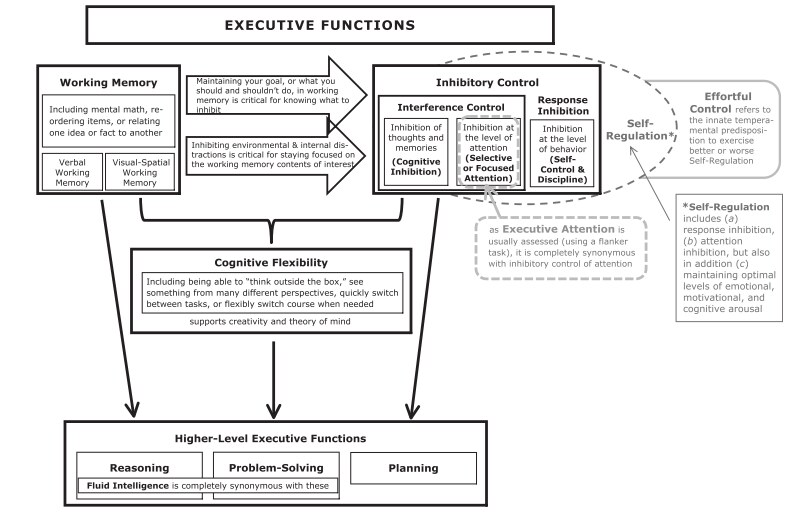
Parallel reviews of cognitive training games and exergames revealed common shortcomings: poor design engagement, short-lived novelty effects, and limited real-world transfer. Critically, these tools often failed to integrate motivational design theory, or neglected the emotional and social context of play — especially in school environments.
From insight to opportunity
Through a gap analysis, I articulated a clear opportunity: to design a motivationally rich, physically active game that challenges EF in a way children find meaningful. Importantly, this meant rejecting the gamification of cognitive assessments in favour of experience-first, player-centred design. I framed the goal as creating a cognitive training tool that would:
- Feel like a game, not a test.
- Fit within real-world school timetables and constraints.
- Support social interaction and emotional growth.
- Allow for adaptive difficulty and strategic depth.
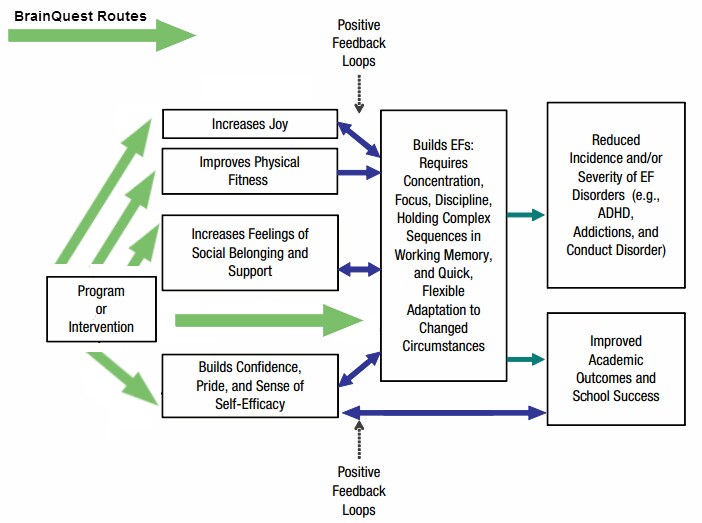
I translated these insights into a set of design requirements that would anchor the project, each grounded in both psychological theory and practical classroom realities.
2 · Requirements gathering & early design
With a clearly defined problem space and theoretical framework, the next stage focused on translating insight into actionable requirements through participatory, user-centred methods. This phase was critical not just for grounding the design in user needs, but for ensuring it would be engaging, usable, and feasible in real school contexts.
Stakeholder engagement & contextual inquiry
I conducted semi-structured interviews and contextual observations with teachers, children, and child-development experts. These sessions explored:
- How cognitive and behavioural challenges manifest in the classroom.
- Practical constraints of time, space, and equipment in primary schools.
- What makes physical and digital activities enjoyable and manageable for 11–12-year-olds.
I paid particular attention to emotional cues — anxiety around rules, fear of failure, and peer influence — elements critical to both user engagement and executive function development.
Co-design with children
To ensure the game would resonate with its intended audience, I ran co-design workshops with primary school pupils using gamestorming techniques. Activities included "design your perfect game" sketching, fantasy character and environment creation, and group ideation on fairness, challenge, and fun.
These sessions not only surfaced rich qualitative data but also empowered children as design partners — boosting future buy-in and surfacing usability expectations that adult designers often overlook, such as preferences for immediate feedback, fairness in scoring, and options to retry after failure.
Design translation & motivational mapping
From this data, I developed a set of experience-driven design requirements, bridging theoretical goals (e.g. promoting working memory and planning) with concrete game mechanics. I mapped elements from Self-Determination Theory and the Player Experience of Need Satisfaction (PENS) model directly onto gameplay structure:
- Autonomy → role switching and task selection.
- Competence → adaptive difficulty and point systems.
- Relatedness → social roles and peer collaboration.
This translation let me make design decisions that served both psychological development and user delight — treating engagement as a functional pathway to executive challenge, not just a side benefit.
3 · Prototyping & iterative development
With a strong foundation of user and stakeholder insights, the focus turned to bringing BrainQuest to life through iterative prototyping. This phase was critical not only for testing usability and engagement but also for solving complex technical challenges around tangible interaction, mobile hardware, and real-time data capture in an active classroom setting.
Rapid prototyping & tangible interface design
I developed a series of three increasingly complex prototypes, beginning with low-fidelity paper mockups and progressing to a fully functional digital-physical system. Early sessions tested rule logic and interaction design using printed cards and verbal roleplay, gradually integrating more advanced feedback, scoring, and data-tracking features based on participant responses.
A major innovation was the creation of a tangible interaction system using Near Field Communication (NFC) — a technology still emerging in mainstream smartphones at the time. Children interacted with physical game pieces (task cards, role tokens, and props) embedded with NFC tags, which they scanned using Android smartphones to trigger actions and record progress in-game.

App development & system architecture
I built the BrainQuest app in Android Studio, developing for mid-range Android smartphones to reflect the likely constraints of future school-based deployment. The app featured:
- NFC-triggered task selection and validation.
- On-device scoring logic, including difficulty scaling and task randomisation.
- Visual feedback interfaces for team status, performance, and rewards.
- Progress-tracking tools — task histories, shared status, and leaderboards — to support strategic planning and memory use.
To ensure gameplay data was captured for later analysis, I implemented a custom PHP + SQL backend, with endpoints for logging performance data, managing user sessions, and storing game histories. This setup enabled real-time logging without the need for persistent internet access — crucial in a busy school setting with patchy connectivity.

Gameplay mechanics & EF integration
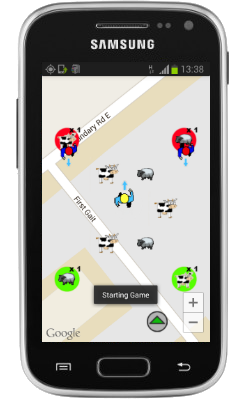
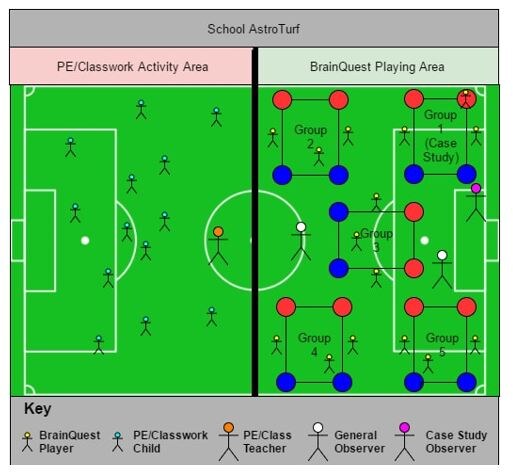
Gameplay revolved around two competing teams — Heroes and Rustlers — each with distinct goals, rotating leadership roles, and limited resources. The physical movement required for tasks, combined with complex decision-making and collaboration, created sustained executive-function demands:
- Working memory — remembering sequences and task dependencies.
- Planning — selecting optimal task orders based on team status.
- Inhibitory control — resisting impulsive choices and following group strategies.
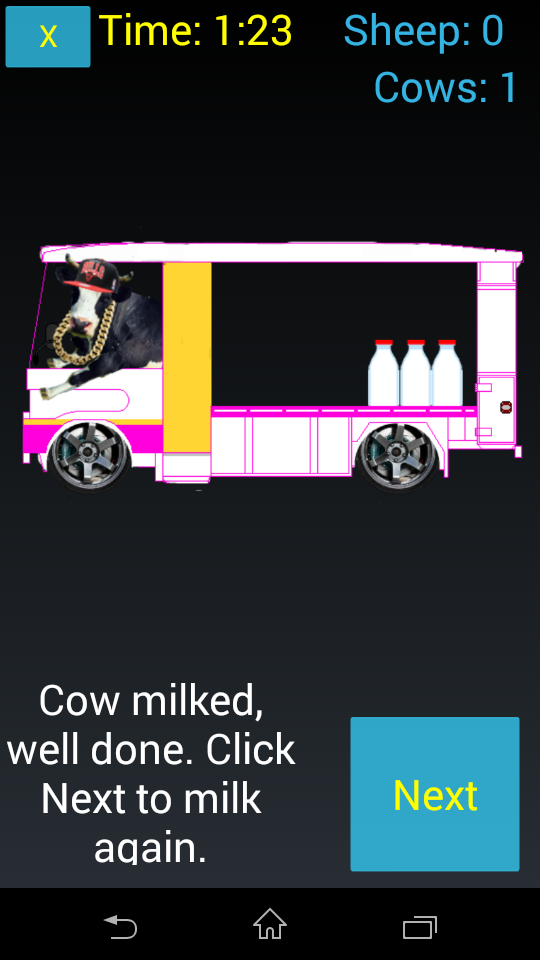
The app's difficulty system adjusted in response to performance, unlocking new levels of complexity over time to maintain challenge and engagement. Playful, bright animal tasks — milking a cow, shearing a sheep, returning rustled animals — gave each round a sense of momentum and reward.

Testing & iteration
Each prototype iteration was tested through short in-school play sessions, observed directly and followed by informal interviews with children and teachers. I refined UI elements for clarity and accessibility, smoothed the interaction flow for scanning and transitions, and improved feedback mechanics to better support reflection and learning. These iterations helped transform the experience from a complex idea into a learnable, motivating, and technically robust system for cognitive development.
4 · Final deployment & mixed-methods evaluation
After three iterative prototypes and multiple rounds of classroom testing, the final BrainQuest system was ready for real-world deployment. This phase was designed not only to assess the feasibility of implementation but to rigorously evaluate the game's cognitive challenge, user experience, and potential developmental impact using a mixed-methods approach.
Study design
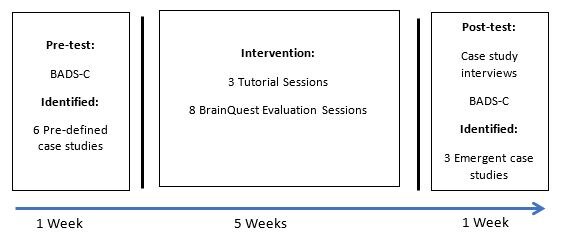
I conducted a five-week school-based intervention with 28 pupils (aged 11–12) in a local Edinburgh primary school. The study was embedded into the school's physical-education timetable to align with real-world constraints. Sessions were held weekly, with pupils rotating through structured BrainQuest games designed to foster planning, memory, and self-regulation through team-based, physically active play.
Ethical approval was secured through university protocols, with parent and pupil consent obtained. The study was carefully structured to ensure that gameplay felt like an enjoyable classroom experience — not a clinical assessment — while still enabling robust data collection.
Data collection methods
I designed the evaluation around a triangulated mixed-methods model, enabling both breadth and depth of insight:
- Quantitative — the BADS-C (6E) executive-function assessment administered pre- and post-intervention, plus in-game performance metrics covering task choices, strategy use, and difficulty progression.
- Qualitative — observations of gameplay and peer interaction, semi-structured interviews with pupils and teachers, and reflections captured during and after sessions.
I also implemented a custom data-logging system to record gameplay sequences, NFC interactions, and user selections — allowing analysis of behavioural patterns over time.
Evaluation outcomes
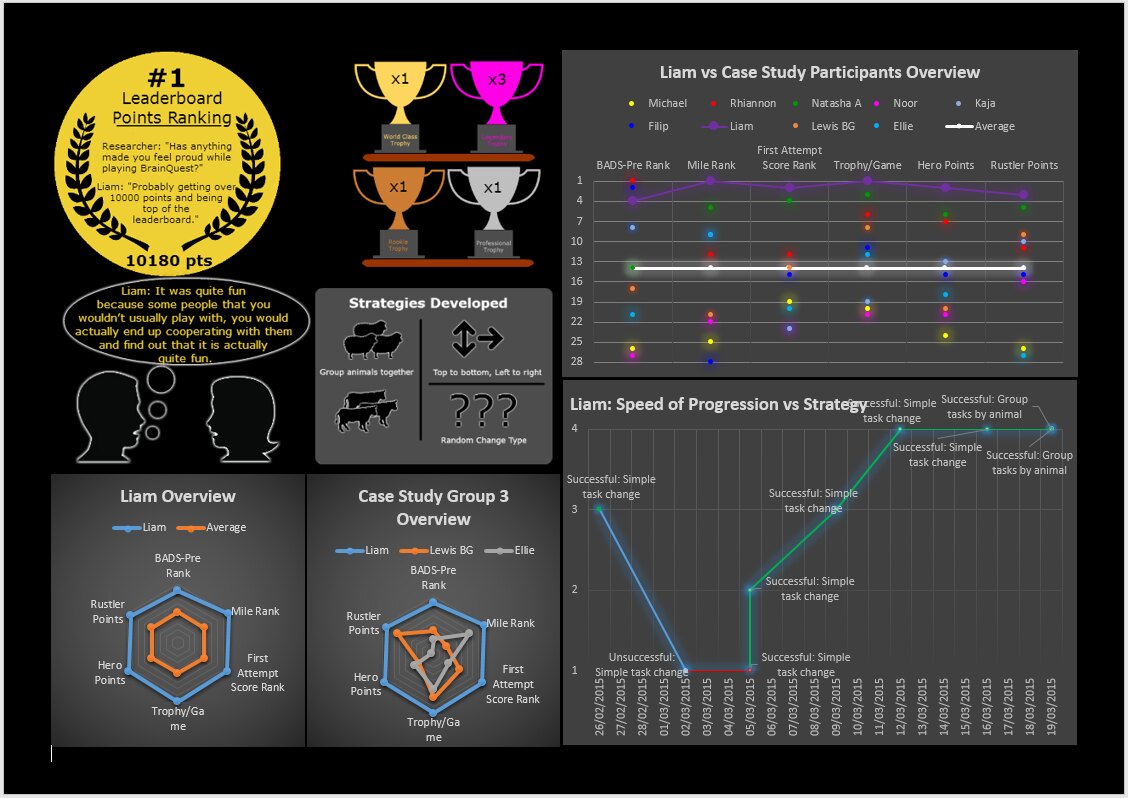
- High engagement and usability. Pupils consistently found the game fun and challenging. Initial learnability issues were largely overcome by week two, thanks to improved support tools.
- Evidence of EF challenge. Players demonstrated sustained use of planning and strategy under evolving task demands. Several in-game metrics — such as task-history use and adaptive behaviour — correlated with improvements in EF scores.
- Social and emotional benefits. Children reported increased confidence, pride, and enjoyment. Teachers observed improved collaboration and regulation among typically disengaged pupils.
While the sample size limited statistical power, the triangulated evidence pointed to meaningful engagement with EF processes and highlighted BrainQuest's potential as a cognitively and socially impactful intervention.
Reflections
BrainQuest taught me that the most effective cognitive tools for children do not look like tests at all. By treating joy, social belonging, and self-efficacy as functional pathways to executive challenge — rather than decoration — the game sustained engagement long enough for genuine cognitive demands to take hold. Embedding the study within a real PE timetable, with all its constraints around time, space, and connectivity, kept the design honest and the findings grounded in lived classroom reality.
Bringing together developmental psychology, motivational game design, tangible NFC interaction, Android development, and a triangulated evaluation in a single project sharpened my conviction that holistic thinking — where theory, mechanics, hardware, and human context work together — resonates far more deeply than any single clever feature.
Keep exploring
More case studies
trove
A digital and physical memory box for looked-after and adopted children.
View case study →
OKKO Space Academy
A mobile game to diagnose and monitor childhood amblyopia.
View case study →
The Sugargotchi
An embodied digital pet to gamify awareness of sugar consumption.
View case study →