Social care · Children · Mobile
trove
A digital and physical memory box that helps looked-after and adopted children capture, safeguard, and revisit the stories tied to their most precious objects.
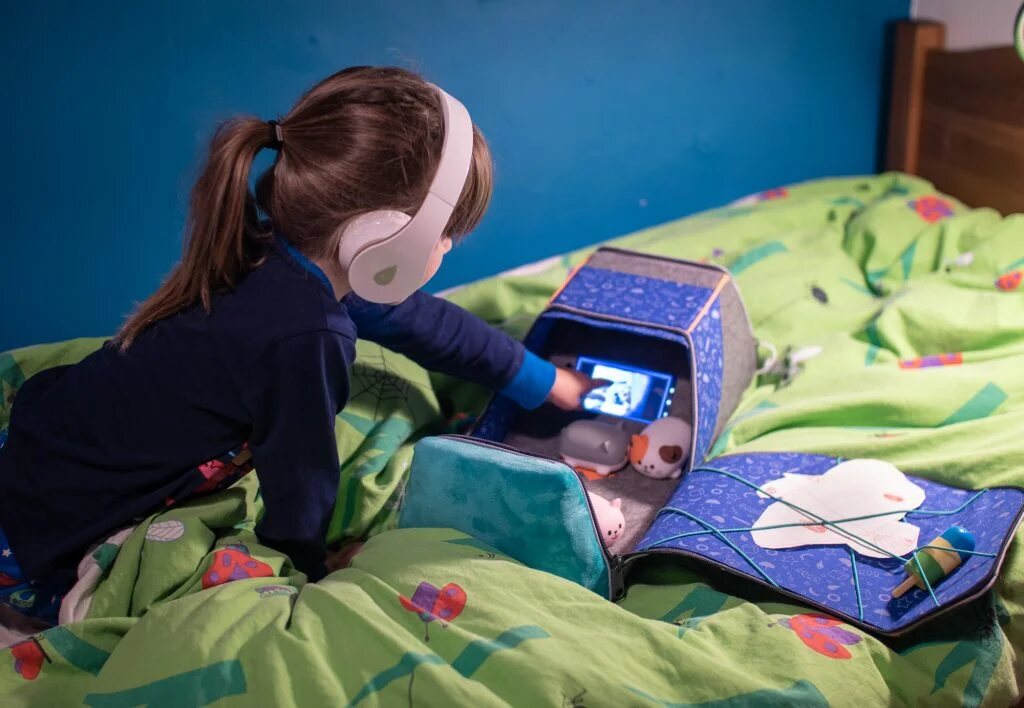
For many looked-after and adopted children, physical objects are often the only touchstone they have to their past — a key to memories of birth families, former homes, and significant people. Through a therapeutic process known as life story work (LSW), reminiscing about these objects can help children reflect on their personal histories and begin to heal from traumatic experiences.
Back in 2013, Professor Debbie Watson of the University of Bristol and designer Chloe Meineck envisioned a digital-physical memory box called trove — a safe, personal space where children could capture and revisit the stories tied to cherished artifacts. Over time, and with sustained contributions from collaborators including Rachel Hahn, Tom Metcalfe, Kirsten Cater, and myself, trove evolved far beyond its initial wooden-box prototype. Following successful pilot trials in 2023 with the Scottish children's charity Articulate Hub, trove is now in active service.
My contribution
I led the UX redesign and software development: reviewing pilot data to identify design improvements; developing the UX strategy and user journey informed by thematic analysis; planning and facilitating workshops with looked-after children using role-play and cultural probes; co-designing user flows for scanning objects and recording private memories; building the Java-based Android app in Android Studio with a focus on accessibility and security; and co-authoring peer-reviewed papers published at CHI and IDC.
Design process
Our process centred on understanding the emotional weight of childhood memories — particularly for those growing up with uncertain family ties and traumatic histories. By combining hands-on workshops, playful prototypes, and careful ethical consideration, we co-created a product that merges physical and digital storytelling, iterating continuously and embracing genuine user participation at every step.
1 · Empathise — understanding the problem space
The important relationship between children and their personal objects is well established, but for looked-after and adopted children such objects carry amplified significance — often the only remaining link to their pasts. Yet these stories can be littered with traumatic events and missing key details, consequences of failures to adequately document a child's arrival into care. Failure to coalesce a congruent, understandable narrative can leave children trapped in a state of hyper-vigilance, detrimental to their growth.
In the UK, life story work attempts to formalise the capture of a child's story upon entering the care system. Physical objects can be a key contributor — but keeping these precious objects safe, within what can be tumultuous, ephemeral living arrangements, is frequently a significant challenge.
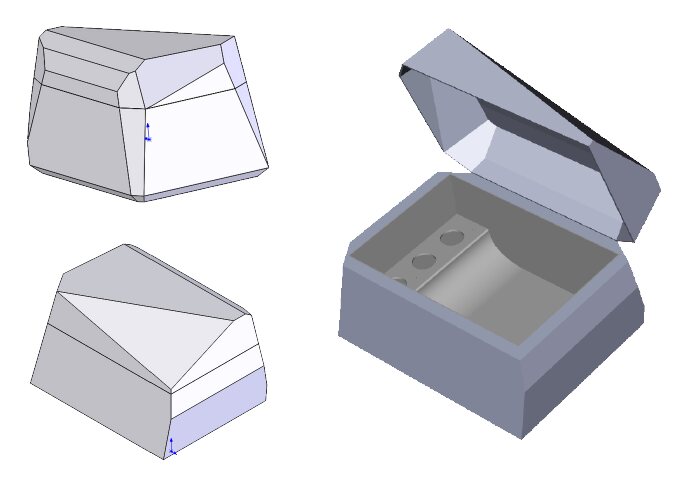
The trove V1 design process
Before I joined, Debbie Watson and Chloe Meineck had already run four bi-weekly workshops with five children (ages 7–9), quickly integrating their ideas into a working prototype. From the start, trove's design aimed to connect objects to their stories, prompt memory retrieval and reflection, offer a safe physical space, stay portable amid abrupt transitions, and remain relevant for a child's entire life.
Inspired by reminiscence technologies used to support people with dementia, V1 emerged as a gem-shaped object with storage space and a technology insert, facilitating audio recording and playback. Links to recorded stories were written to RFID tags attached to objects and replayed by scanning the tag. An inbuilt warm, humanistic voice prompted the user through each interaction, making it accessible to very young children, while an archive ensured nothing could be accidentally or maliciously deleted.
My introduction to the trove team
While I wasn't involved in V1, analysing its evaluation sessions marked my first involvement. The team needed UX research expertise to make sense of the data and synthesise it into a redesign strategy. I'd worked with children before, but never with looked-after and adopted groups, and never in the world of social work, life stories, and trauma recovery. What followed reshaped the way I approached empathising with users, viewed children's behaviour, and valued designing for under-represented groups.
Qualitative analysis
I brought all available notes and transcripts into NVivo for a two-pronged inductive/deductive thematic analysis — first coding against broad LSW-informed categories, then surfacing new inductive themes on a second pass. To validate, my colleague Rachel Hahn coded independently; we compared, merged overlapping insights, and refined discrepancies into a set of key themes for the team.
The analysis revealed trove V1 held clear promise: preserving precious memories, enhancing narrative depth (children saw it as an interactive diary, no writing required), facilitating difficult conversations, and bridging gaps in life story work. But opinions on the physical prototype varied widely around storage, discretion, and security.
2 · Define — setting a design agenda for V2
Testing revealed assumptions stemming from V1's original creation, which hadn't fully involved children from looked-after or adopted backgrounds. Under Alison Druin's model of child participation, children had mainly acted as design informants. From the analysis, clear requirements emerged for V2:
- Remain relevant across the lifespan, adapting to children's evolving identities.
- Emphasise child-led storytelling while respectfully incorporating caregiver and social-worker perspectives.
- Safeguard objects and stories equally.
- Capture memories without physical artifacts, for when items are lost.
- Enhance portability — lightweight and discreet across living situations.
- Promote story sharing with trusted individuals.
- Ensure economic feasibility for local authorities and charities.
3 · Ideate — user-centred redesign workshops
We worked with a therapeutic residential school to host four 60-minute workshops with four looked-after children (aged 11–13). Each child had a history of trauma, so we invested heavily in ethical planning: a child psychotherapist reviewed activities, written and verbal consent was obtained, activities were piloted with a fostered teenager, and staff stood by throughout to provide emotional support.
A creative, emotionally safe workshop process
Taking inspiration from constructivist and constructionist learning, and from Child-Computer Interaction and LSW, we used playful methods rather than asking children to present personal mementos:
- Lego / Plasticine modelling — turning abstract ideas into tangible, safer-to-share creations.
- Role-play & board games — children played "secret agents" protecting fictional objects, lowering the emotional stakes around privacy and security.
- Cultural probes — probe kits with a notepad, audio recorder, and disposable camera let children record stories in their own time and setting.
- Observation & hybrid thematic analysis — gathering audio, photos, and field notes, then debriefing after each session.
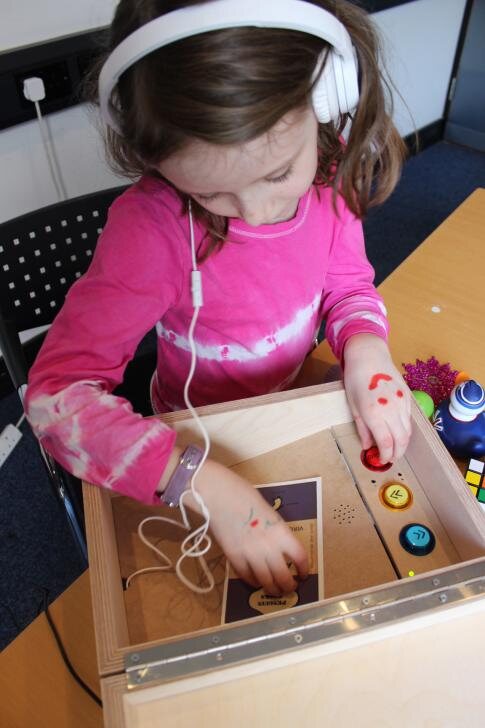
The workshops surfaced new insights: children told sensitive narratives more freely when they could choose the medium; many used soft toys for emotional comfort; some wanted objects in plain sight, others hidden; objects could hold one powerful memory or an evolving set; and crucially, privacy fostered deeper sharing — given time alone with cultural probes, children produced unexpectedly elaborate, emotional narratives.
4 · Design & Develop — translating ideas into trove V2
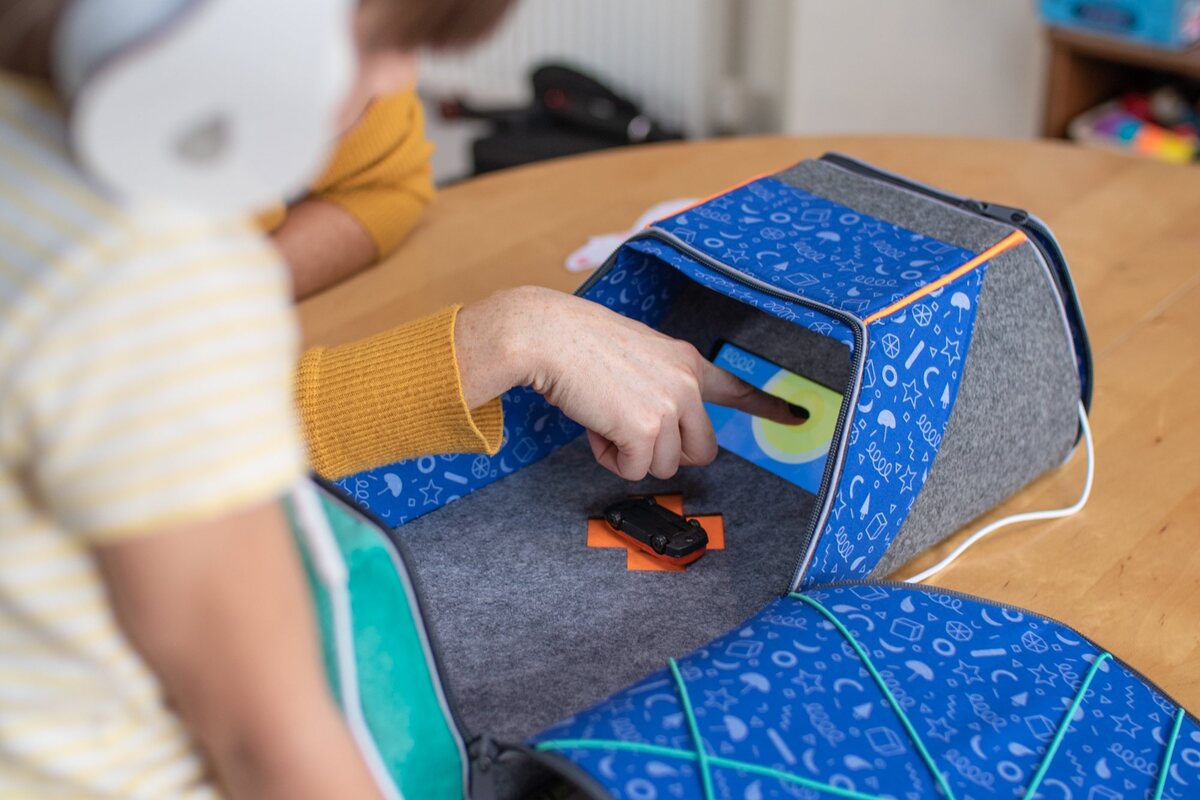
We wanted trove to feel less like an impersonal device and more like a comforting companion. trove V2 is a large, lightweight, portable felt bag that conceals a smartphone-based system. An NFC scanning platform lets children link and instantly replay the stories tied to each object's tag, sustaining trove's signature tangible connection between objects and narratives.
Designing with user journeys
We mapped journeys mirroring stories shared in workshops. For "Trisha," an 11-year-old in residential care who enjoys writing diary entries at night:
- Trisha settles into bed with her favourite object and her trove bag.
- She unzips trove, places her object on the orange "X" marker, and scans its NFC tag.
- The hidden touchscreen pulls up her existing stories and, in a gentle tone, asks if she'd like to add a new memory.
- She records her thoughts into the headphone-mic and takes a quick photo with the front camera.
- She zips trove shut, knowing her story is safely stored — locally and in the cloud.
trove: the life companion
Constructed from bedtime-friendly felt, V2 can double as a cushion. The discreet charcoal-grey exterior blends into environments where privacy matters; once unzipped, the bright blue interior — embellished with teddy bears, shells, hearts, and stars — feels warm and inviting. A pull-out encapsulation screen and headphone ports preserve privacy, while a shoulder strap helps children carry their stories between homes.
A screen-based interface
To meet multiple imperatives at once, we used an entry-level smartphone (a Vodafone N9, approx. £30) housed in a removable plastic insert — multimedia-friendly, economical, and easily replaced. It powers a playful Java application with bright visuals and lively animations.
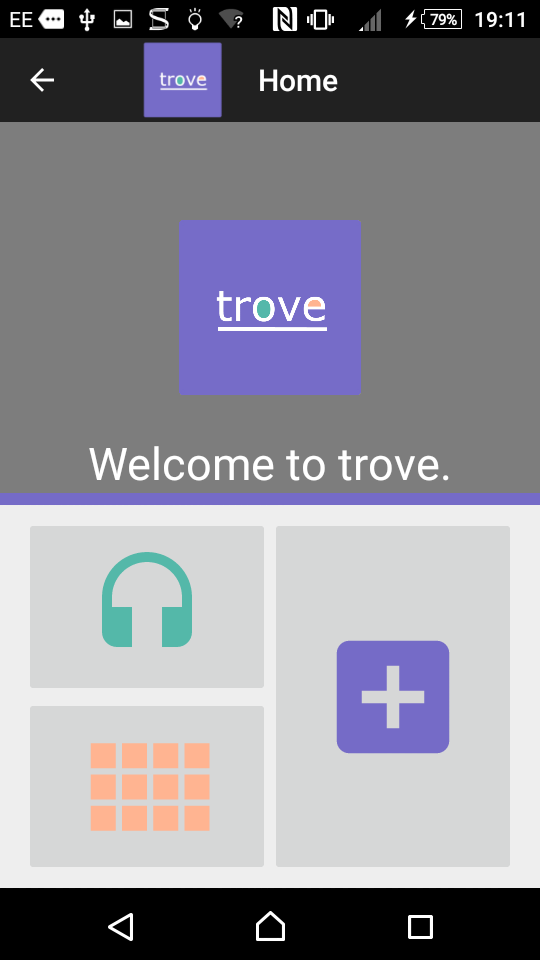
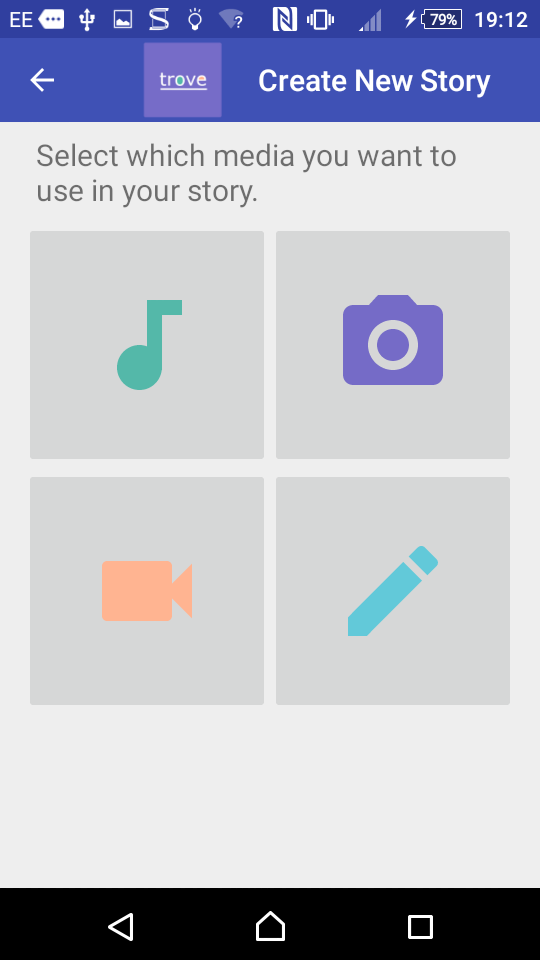
Core interactions include pressing and holding a central record button (which changes colour while speaking), capturing photos and video, and linking objects via NFC. Navigation relies on big icons and simplified text for younger or pre-literate users. For longevity and safety: a subset of vital stories stays on the phone for quick access, with a larger library backed up to Google Firebase; all data is protected by 256-bit AES encryption; and login uses a non-text passcode — selecting a sequence of object images — respecting pre-literate users.
5 · Launch — showcasing trove
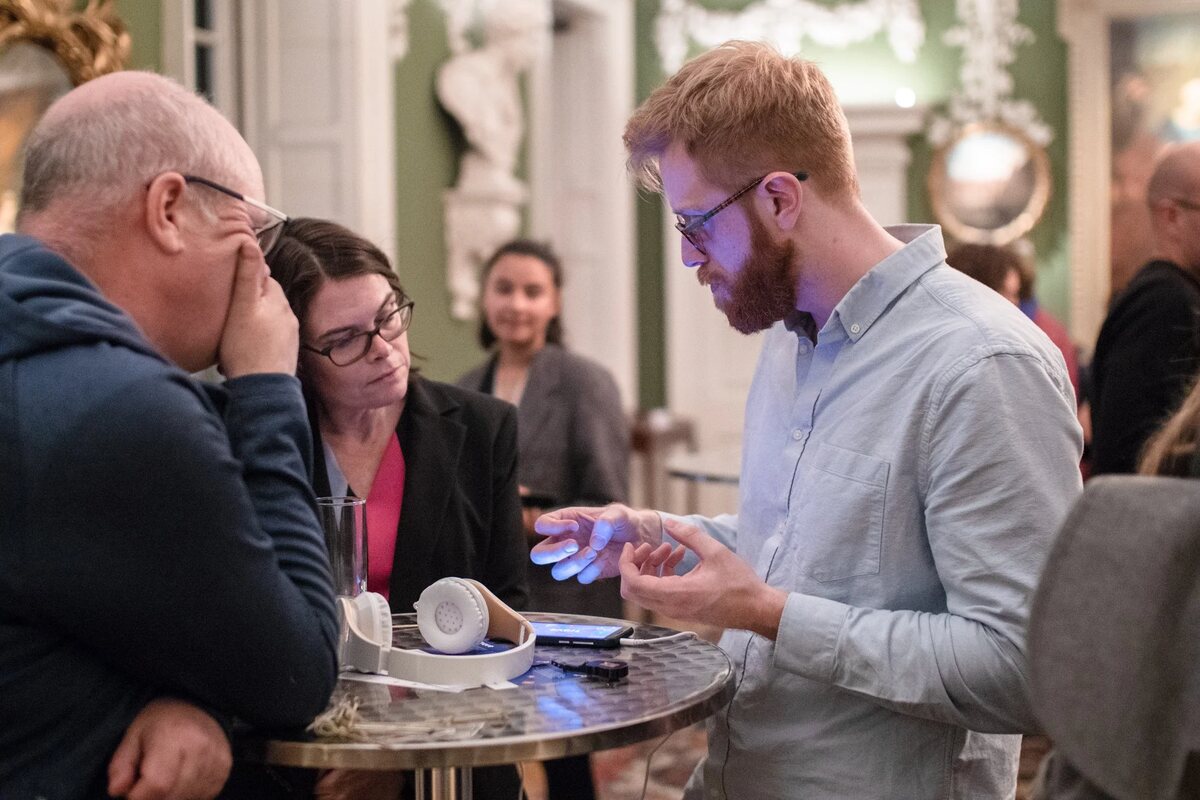
We hosted a launch event at the Foundling Museum in London — a fitting venue given its historical ties to children's welfare. A few hundred guests gathered, spanning care professionals, charity workers, designers, foster parents, and adults who had once been in care. We recounted trove's evolution from proof-of-concept box to felt-based V2, passing both versions around during a live demo. Many were visibly moved by the children's recorded narratives.
Our IDC paper explored the in-depth analysis of trove V1, while our CHI paper focused on the V2 redesign process. Both talks earned honourable mention awards — validating not only the technical innovation but the commitment to championing the experiences of looked-after and adopted children.
Reflections
Working alongside looked-after and adopted children underscored the delicate balance between empowerment and protection. These interactions transformed me into a more compassionate, user-centred designer — I learned to slow down, listen more acutely, and adapt methods midstream to ensure children's comfort and emotional safety.
The transition from a button-based box to a touchscreen-based bag offered multimedia capability, robust security, and a scalable path for the 70,000+ looked-after children in the UK — while teaching me that holistic thinking, where a product's voice, material, and interface work together, resonates far more deeply than any single feature. Above all, technology alone is rarely the full answer; it must be integrated into the human environment surrounding the child.
Selected publications
Gray, S., Hahn, R., Cater, K., Watson, D., Williams, K., Metcalfe, T. & Meineck, C. (2020). Towards a Design for Life: Redesigning for Reminiscence with Looked After Children. CHI 2020.
Gray, S., Cater, K., Meineck, C., Hahn, R., Watson, D. & Metcalfe, T. (2019). trove: A digitally enhanced memory box for looked after and adopted children. IDC 2019.
Keep exploring
More case studies
OKKO Space Academy
A mobile game to diagnose and monitor childhood amblyopia.
View case study →
The Sugargotchi
An embodied digital pet to gamify awareness of sugar consumption.
View case study →
Gorilla Game Lab
Digital and tangible playable interfaces to improve the welfare of zoo-housed gorillas.
View case study →