Animal-computer interaction
Gorilla Game Lab
A modular, physical-digital enrichment system that reframes the daily lives of zoo-housed gorillas as adaptive, interactive cognitive play — combining gorilla-proof puzzle hardware with IoT sensing to improve welfare and inform behavioural research.
Picture a 400-pound western lowland gorilla, sitting in a zoo enclosure day after day, eyeing the same old toys and climbing structures. Traditional enrichment tools — basic feeders, destructible toys, novelty items — often fail to hold interest over time. They offer limited cognitive stimulation and can contribute to boredom, apathy, and the development of stereotypic behaviours. Gorilla Game Lab was an interdisciplinary research and design project focused on improving the cognitive wellbeing of zoo-housed gorillas through long-term enrichment.
Our goal was to reframe enrichment as an adaptive, interactive experience — something that could evolve alongside the gorillas' capabilities and encourage ongoing exploration, problem-solving, and learning. The solution we developed was a modular, physical-digital enrichment system that combined robust, puzzle-based hardware with IoT-connected sensors and remote monitoring. Puzzle components could be reconfigured to introduce new challenges, while the system's digital infrastructure provided behavioural data to zookeepers and researchers, supporting more tailored enrichment strategies over time. The project pushed the boundaries of animal-computer interaction, combining tangible interaction design with a genuine commitment to animal agency — and sparked wider conversations about ethical, welfare-led technology in captive animal environments.
My contribution
As team lead, I oversaw all aspects of the project: securing project funding and managing milestones, deliverables, and procurement; defining the research strategy and coordinating delivery of technical, design, and evaluation work; leading stakeholder engagement across the University of Bristol, Bristol Zoo, and international partners; and co-leading the ideation and early design phases, drawing on my background in game design to envision enrichment as a meaningful form of cognitive play. I also authored peer-reviewed publications, presented at conference, and led media outreach.
The collaborators
Gorilla Game Lab was the product of a deliberately cross-disciplinary team, where animal welfare science, creative technology, and learning psychology met around a single table:
- Fay Clark — Animal Welfare Scientist. With years of zoo experience specialising in animal welfare and cognition, Fay led our efforts to empathise with our key stakeholders, understand animal enrichment, deliver ethical design, and structure and implement evaluation activities at Bristol Zoo.
- Peter Bennett — Player Experience Designer. A creative technologist with a catalogue of tangible user interfaces, Peter co-led the ideation and design phases and led the development of the physical and digital prototyping activities.
- Katy Burgess — Player Psychologist. Leaning on her expertise in human and animal learning and reasoning, Katy led the application of psychological principles within the prototype designs to support animal welfare and engagement, and analysed zoo visitor perceptions.
Process overview
Designing Gorilla Game Lab was a journey of creativity, collaboration, and problem-solving. From understanding the complex needs of zoo-housed gorillas and their caretakers to iterating on innovative prototypes, the process embraced a user-centred approach grounded in empathy and research. Each stage was crucial in transforming initial insights into a robust, modular enrichment system that promotes cognitive engagement and improves welfare.
1 · Empathise — thinking like a gorilla
Gorillas are, in many ways, the original puzzle masters. Despite popular cartoons, bananas aren't always on the menu — zoo staff often skip them to avoid excess sugar, while peanuts make a great treat. The real secret to keeping these gentle giants engaged is to tap into their natural curiosity and intelligence. Before we could design anything, we needed to understand three intertwined sets of needs.
- Cognitive needs. Gorillas thrive on problem-solving — elaborate puzzles, hidden treats, and novel tasks that stimulate their minds. Providing these mental challenges can reduce boredom and stereotypic behaviours, enhancing overall welfare.
- Physical constraints. These animals are incredibly strong. Any enrichment system must be built from sturdy, "gorilla-proof" materials capable of withstanding a playful tug from massive hands.
- Motivational factors. Reward-based tasks like treat-dispensing puzzles grab attention, but the key is longevity. If a task becomes too predictable, gorillas lose interest. Our goal was a system that evolves as the gorillas' skills improve.
Meeting the gorilla troop
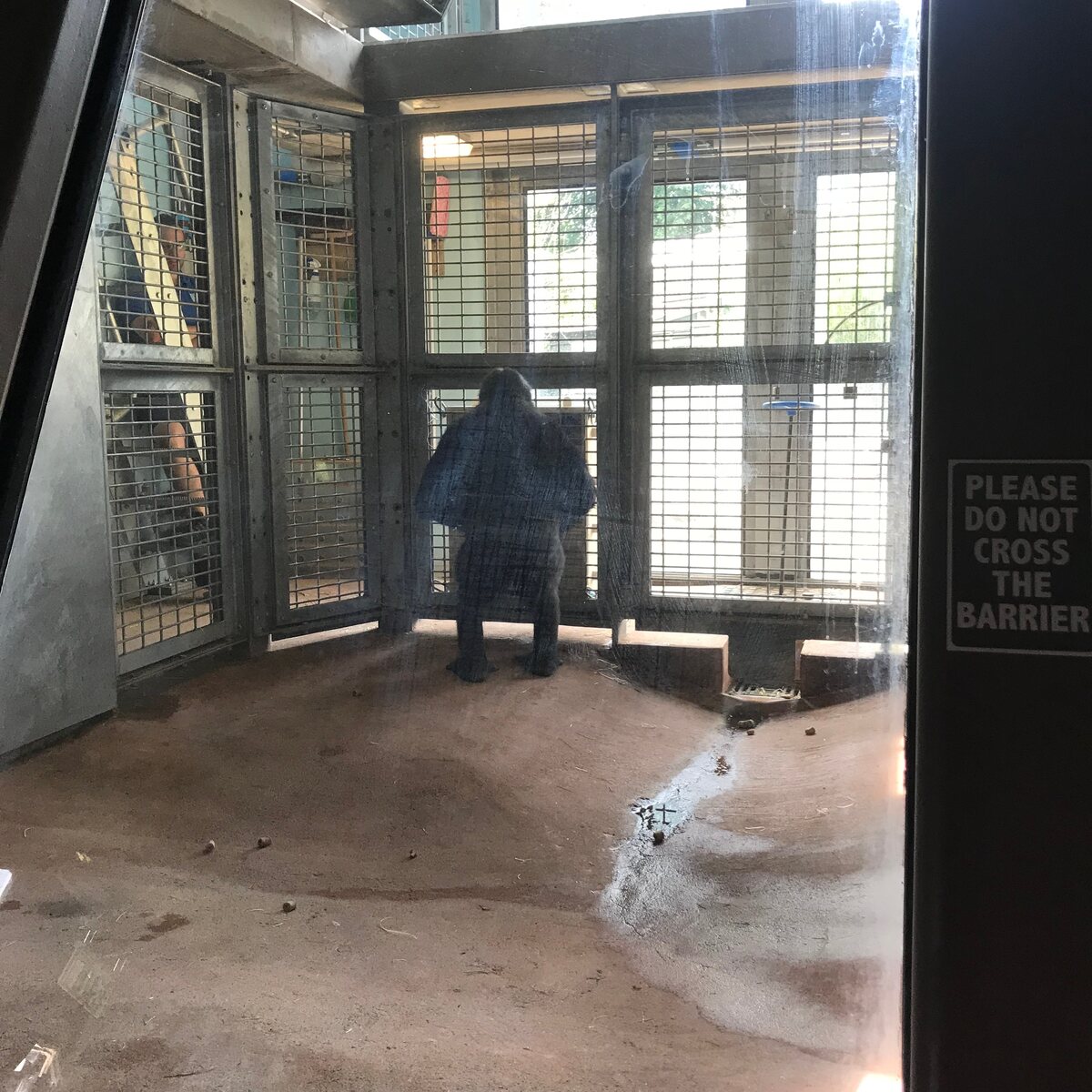
At the heart of the Gorilla Game Lab experience was a vibrant, real-life troop of western lowland gorillas, each with their own personality, backstory, and role in the group. Living at Bristol Zoo Project, they served as both inspiration and co-stars in our design process. Jock (35) was the protective silverback and leader — calm, strong, and watchful; Romina (38) the caring, nurturing mum and a stabilising force; Touni (11) the confident, assertive mum; Kera (14) the curious teenager finding her identity; Kukeña (7) the playful, mischievous tearaway; Kala (7) the cheeky newbie still finding her place; Afia (2) the bright, observant wonder child; and Ayana (1) the baby, a delight to the troop and visitors alike. Together they form a social ecosystem — and any design had to respect the dynamics between them.
Zoo staff & caretakers: balancing safety and enrichment
Behind every content gorilla is a dedicated team of zookeepers managing feeding schedules, enclosure cleaning, and health checks. They wanted enrichment that's easy to set up but also meets strict safety standards — no loose parts that could pose a choking hazard, and surfaces that can be quickly sanitised.
- Daily schedules. Caretakers juggle many tasks at once, so an enrichment system must fit seamlessly into their routines without lengthy instructions or extensive prep.
- Safety & maintenance. From structural integrity to material toxicity, keepers have a checklist to ensure no harm comes to the animals. Equipment must be safe, easy to clean, and built for the long haul.
- Data collection. Researchers and staff are eager for tangible insights — how long gorillas engage with a puzzle, and how behaviours change over time — to refine enrichment strategies and contribute to science-based best practice.
Research activities: observing, listening, and reading
Under the watchful eye of zoo staff, I spent time at the enclosure quietly watching how the gorillas interacted with existing enrichment items — a hands-on perspective that brought to life which puzzles captured their interest and which fell flat. Interviews with zookeepers revealed the intricacies of day-to-day operations: how they introduce new toys, how often they rotate items, and what challenges arise when a tool isn't robust enough for gorilla strength. A literature review across zoo enrichment research and animal-computer interaction studies surfaced best practices for designing cognitive challenges — teaching us that novelty, variability, and a gradual escalation of difficulty are vital for prolonged engagement.
Fun fact
While cartoons depict gorillas devouring bananas, these high-sugar fruits are rarely offered in zoos. Instead, gorillas often snack on peanuts as part of a balanced diet — an excellent incentive for puzzle-based enrichment.
2 · Define — shaping challenges for curious minds
After immersing ourselves in the gorillas' environment and learning about zookeeper workflows, we honed in on a core challenge: how can we give these intelligent animals fun, ever-evolving puzzles — without burdening staff or jeopardising safety? That question drove us to articulate a clear problem statement and vision.
Our vision built directly on that need: to deliver a modular, cognitively stimulating enrichment system that enhances the daily lives of zoo-housed gorillas. By balancing physical durability, cognitive engagement, and ease of use for zookeepers, the system would set a new standard for animal-centred design in enrichment.
Key requirements
From our research, five essential requirements emerged for the solution:
- Durability. Materials must endure powerful hands and curious minds — think thick acrylics or reinforced metals, with no sharp edges or toxic coatings. Every component is "gorilla-proof," ensuring both safety and longevity.
- Adaptability. Modular components let zookeepers mix and match puzzle pieces, adjusting difficulty as gorillas grow more adept. This variability keeps both new and seasoned gorillas mentally stimulated.
- Equitable access. To respect troop social dynamics, the system should feature multiple interaction points or simultaneous activities, so no single individual monopolises the fun.
- Ease of use. Setup and teardown must be quick, cleaning straightforward, and daily operation must fit seamlessly into busy keeper routines.
- Behavioural monitoring. Built-in sensors or cameras capture how often and how intensely gorillas engage with each module, feeding ongoing behavioural research and guiding future refinements.
3 · Ideate — monkeying around with ideas
Armed with insights from zookeepers, researchers, and designers, our team set out to balance durability, cognitive challenge, and zookeeper-friendly features. Above all, we wanted to develop something gorillas would genuinely enjoy long-term. Through structured, user-centred ideation sessions, we surfaced creative puzzle concepts that evolved well beyond the typical "feeding toy."
How we brainstormed
To spark fresh ideas, we adapted a "Crazy 8s" workshop — an iterative design method typically used in UX projects — for zoological enrichment:
- Lightning-round sketches. Each participant, from zookeepers to engineers, drew eight quick ideas in eight minutes, focusing on gorilla-friendly puzzles or modules.
- Group review & feedback. We pinned the sketches on a board and discussed which concepts showed the most promise for durability, engagement, and staff feasibility.
- Refinement & merge. We combined similar or complementary ideas into unified prototypes, zeroing in on those that could withstand gorilla strength and still fascinate them over time.
Every concept arose from a single question: how do we keep gorillas mentally stimulated — every day, week, and month — while ensuring the system remains practical for zookeepers? That framing produced a handful of complementary directions:
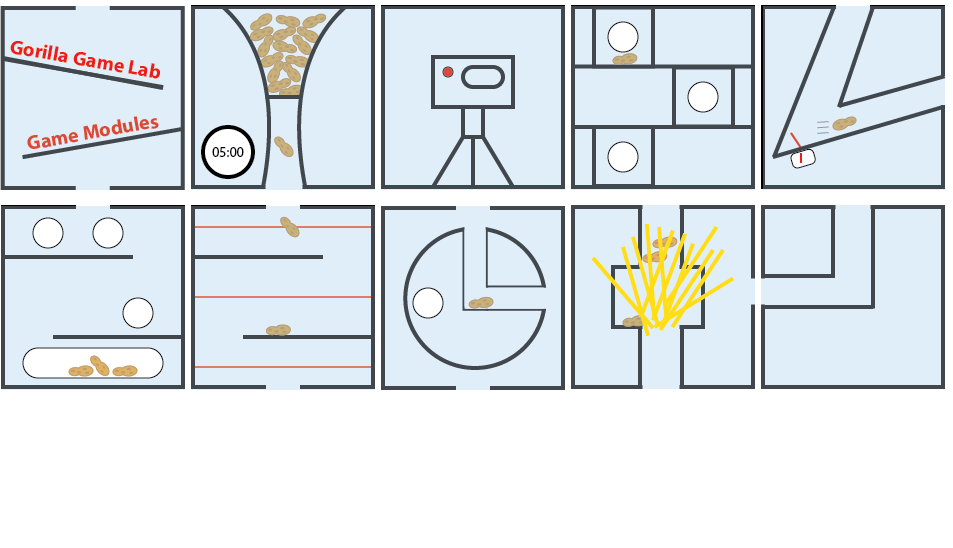
- Modular puzzle system. A suite of swappable modules, each offering a unique cognitive challenge — aligning sliders or manoeuvring rods to unlock hidden treats. Mixing and matching would let keepers adapt difficulty to a troop's evolving skills without staleness.
- Tangible interaction focus. Emphasising physical manipulation — pulling, twisting, sliding — to leverage gorillas' natural instincts for tactile exploration, rather than relying on static or purely digital interfaces.
- Social play features. Multiple access points and puzzle stations designed for group interactions, preventing dominant gorillas from monopolising enrichment and encouraging social bonding.
- Reward integration. Hidden treats — peanuts, fruit — scattered within puzzle compartments to offer immediate positive feedback and give gorillas a reason to return day after day.
- IoT-enabled behaviour tracking. Embedded sensors (infrared beams, accelerometers) and optional camera mounts to record interactions, helping researchers collect data on time spent, success rates, and favoured puzzle types.
Low-fidelity prototypes
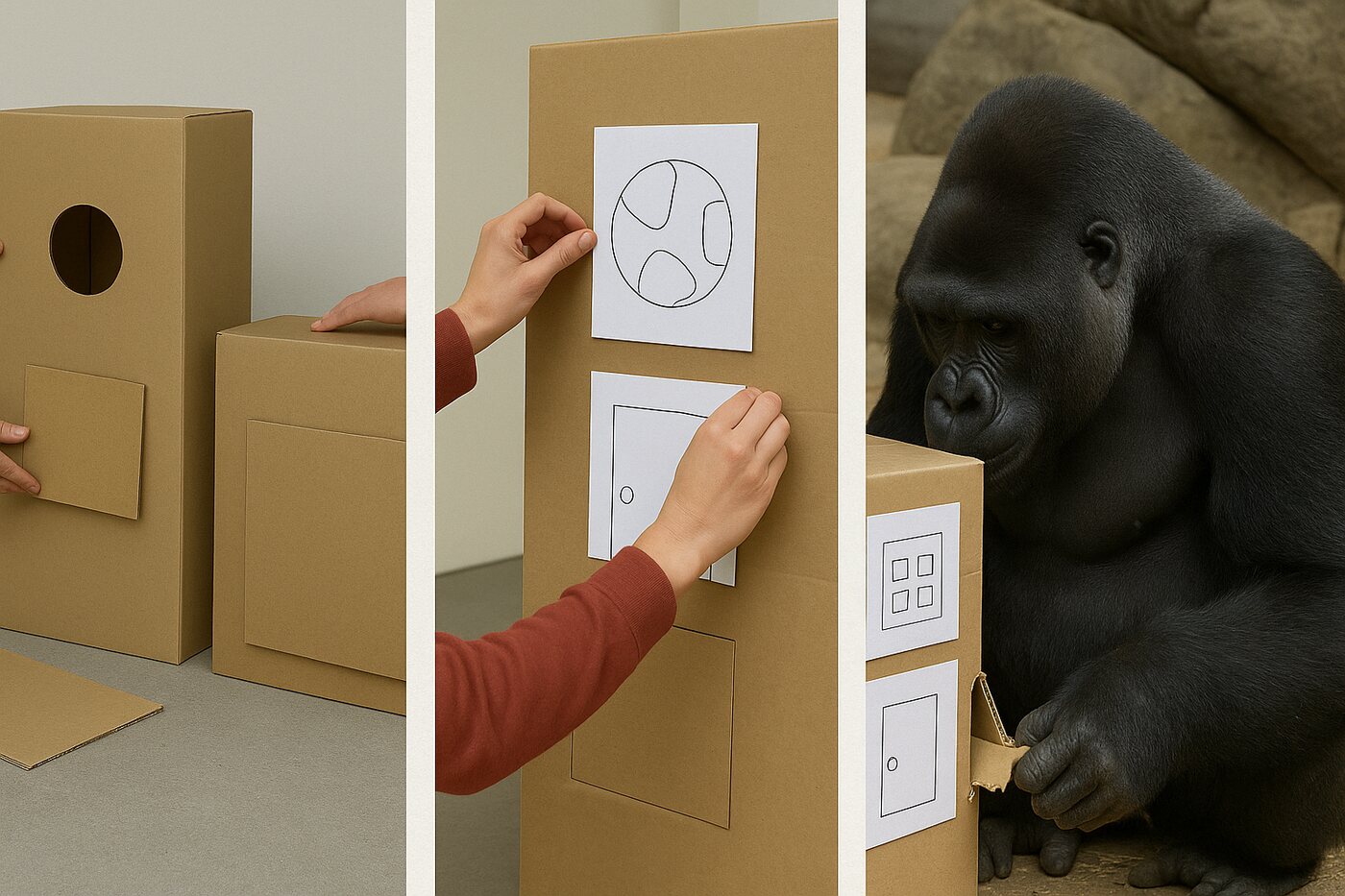
Before jumping into expensive builds, we started simple — using cardboard and paper to quickly bring ideas to life and test assumptions without risk. We began by constructing full-size puzzle mockups out of cardboard, allowing zookeepers to immediately flag concerns around scale, safety, and interaction points. Loose flaps and vulnerable edges quickly showed us where durability would matter most. Next, we layered tactile interfaces onto these mockups — different gorilla-friendly materials to explore — which let us iterate rapidly on layout and mechanics without committing to materials too early.
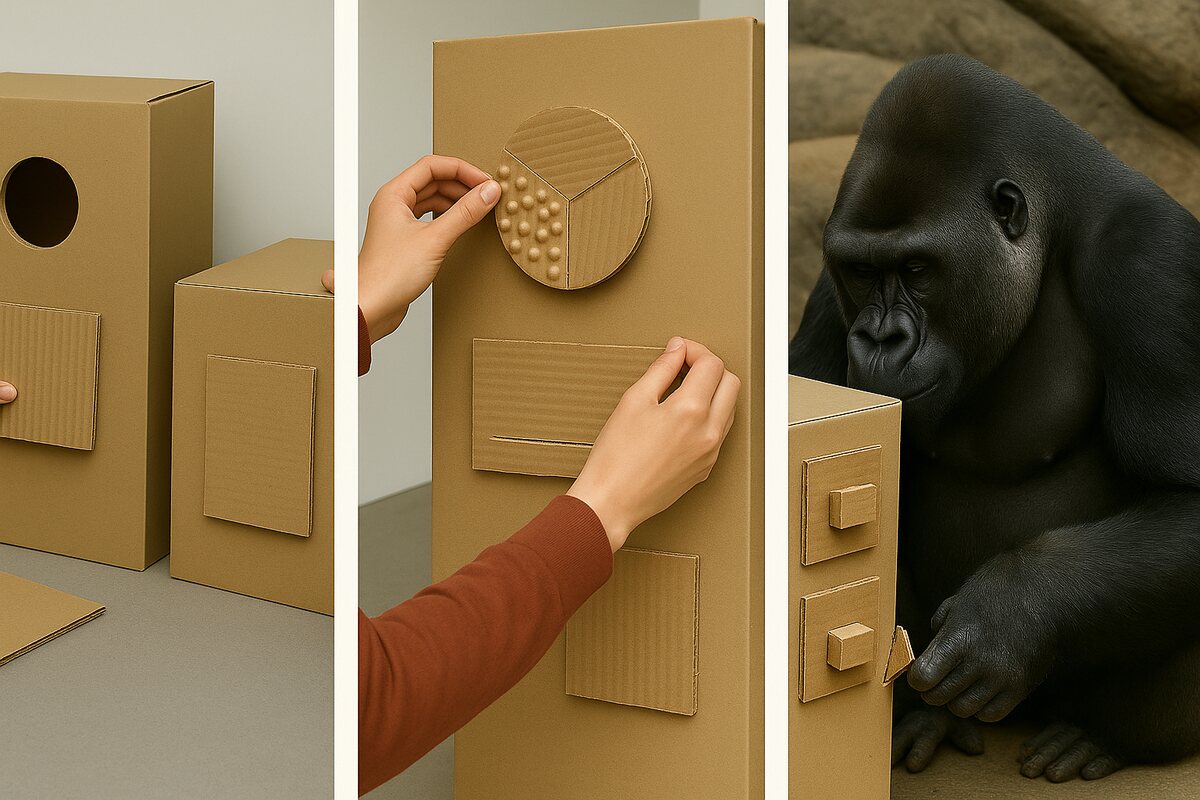
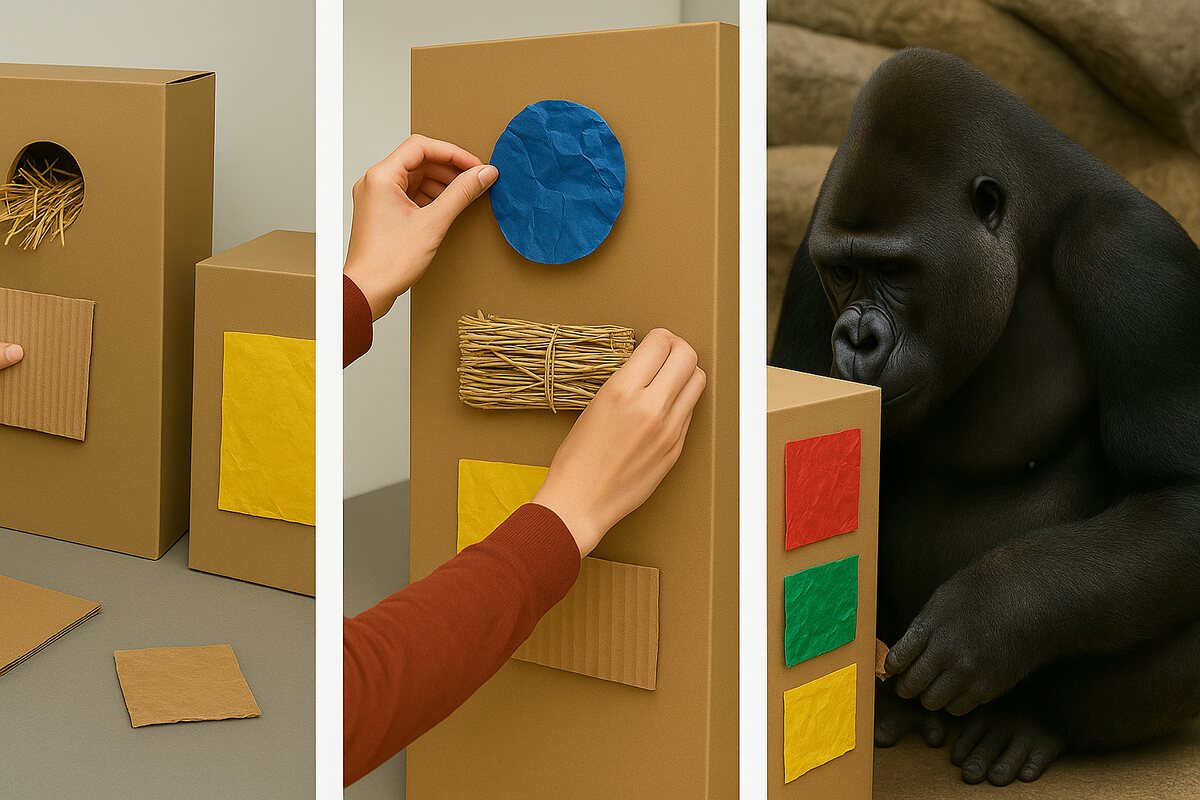
Finally, we placed the non-durable prototypes into the enclosure to observe the gorillas' initial reactions. They were instantly curious — pushing, tearing, and exploring each element with delight. While the prototypes didn't last long, the insight was lasting: tactile engagement is vital, but durability is non-negotiable.
From keeper insights to design direction
As a research team, we watched closely as the gorillas chewed, smashed, and enthusiastically dismantled our cardboard designs. This confirmed both their interest and the need for far more durable, gorilla-proof materials. It also led us to reconsider the structure of future versions: to avoid loss or damage, we would need to secure later prototypes directly to the enclosure — supporting their integrity and making them easier to retrieve for maintenance or iteration.
Zookeepers emphasised the importance of novelty and rotation, urging us to design modules that could be swapped out regularly to sustain interest. They reinforced a key motivator — food; without a treat at the end, enrichment often loses its appeal. And crucially, while keepers could see signs of interaction, their demanding schedules meant they often couldn't track how long or how frequently the gorillas used the puzzles. This highlighted the value of integrating sensors or lightweight tracking to capture engagement data automatically, without adding to staff workload.
Selected direction: the modular puzzle system
After iterating on sketches and validating early concepts, one idea stood out: a modular, reconfigurable puzzle system. Its interchangeable parts let puzzles grow in difficulty and variety as gorillas developed new skills; its fixed, chew-proof components ensured longevity and met zoo safety standards; and each module offered a progression path that encouraged repeated use without becoming predictable. This direction balanced the practical needs of staff with the evolving intelligence of the gorillas — laying the groundwork for a smart, durable, research-ready enrichment platform.
4 · Design & Develop — gorilla-proof or bust
Transitioning from cardboard concepts to a fully functional, gorilla-proof system required more than sturdier materials — it demanded a holistic approach that could stand up to the strength of a 400-pound primate while staying easy to handle for busy staff. The result was a modular puzzle framework that seamlessly integrated IoT sensors, was safe and adaptable, and consistently provided fresh challenges to keep even the smartest gorillas on their toes.
Modular puzzle framework
First, we built a robust frame to mount on the enclosure walls. Constructed from 12mm plywood and 5mm cast acrylic, the frame combined durability with easy-clean surfaces — crucial for zoo environments. Removable wooden pegs secured the interchangeable modules, ensuring no stray parts could end up in a gorilla's mouth. By mixing and matching modules within this framework, zookeepers could easily switch up the difficulty, preventing boredom week after week. Because gorillas are four to ten times stronger than humans, every piece of wood, acrylic, and hardware was tested with the understanding that it might be yanked, twisted, or pounded by curious hands.
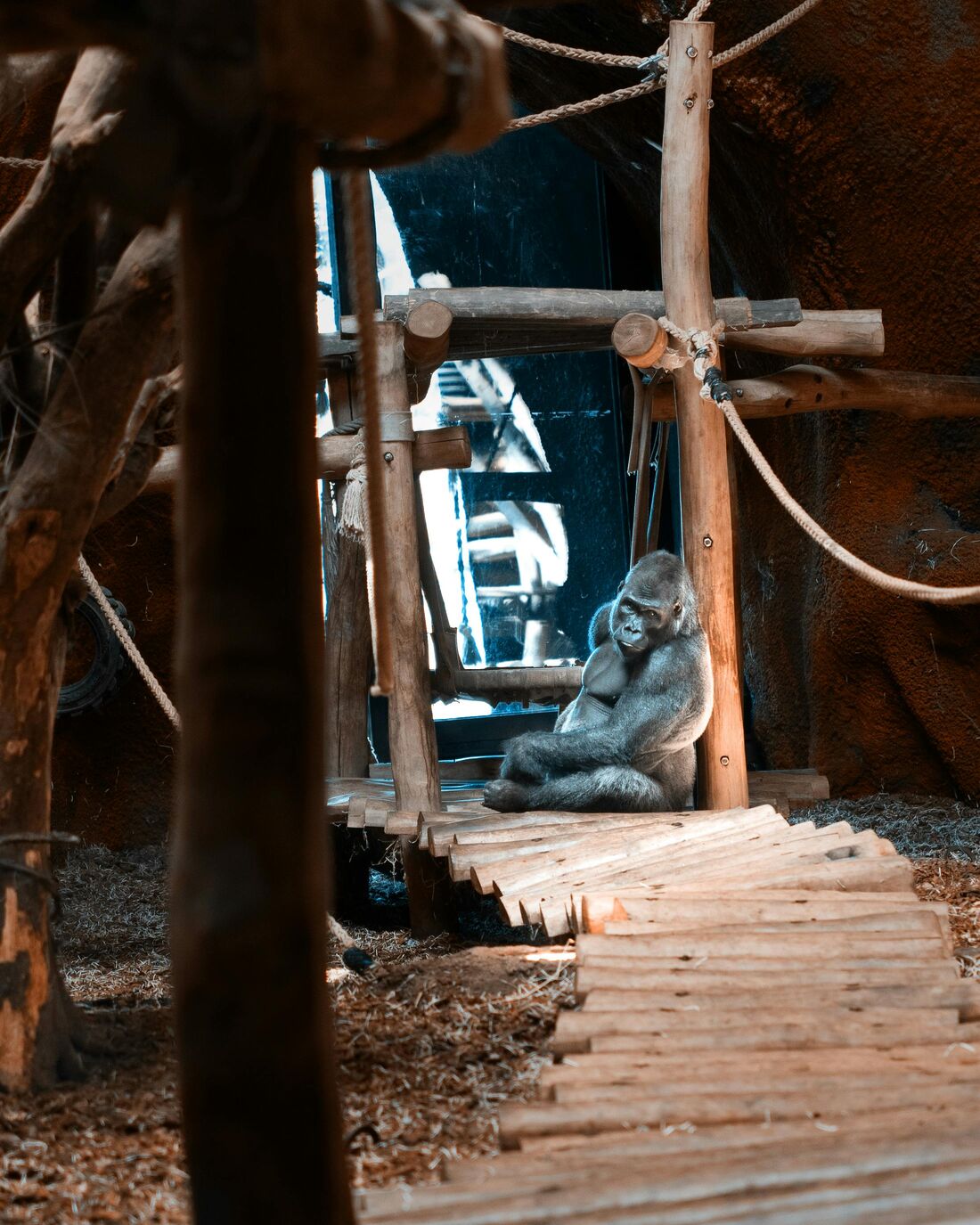
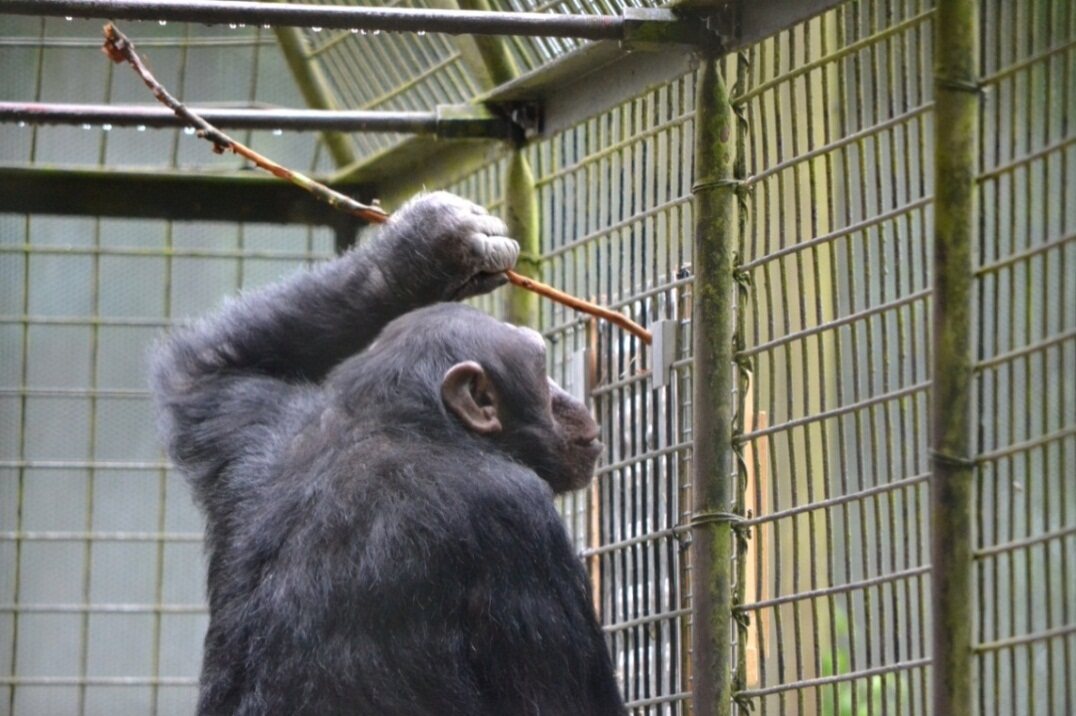
Interaction modules
Each module brought a unique cognitive challenge that featured the physical manipulation gorillas love. Three standout examples illustrated the range:
- Kerplunk module. Gorillas removed sticks or rods to release hidden treats — perfect for encouraging dexterity and problem-solving.
- Slider module. Multiple sliders had to be aligned to open a compartment; the payoff was a reward that dropped into reach once everything lined up.
- Downfall module. A rotating dial guided morsels along a maze-like path — the gorilla had to turn it just right to free the treat.
By alternating these modules, zoo staff could scale the puzzles' complexity over time, keeping the experience fresh and cognitively challenging.
IoT integration
To capture how gorillas interacted with each module, we embedded sensors and a Raspberry Pi for real-time data collection. Infrared break beams logged movements between modules, indicating when a stick was pulled or a slider shifted, while piezo microphones monitored vibrations and impact levels — painting a picture of how forcefully or gently the gorillas approached each puzzle. All data travelled to a cloud-based dashboard accessible by zookeepers and researchers, showing which modules got the most play and the time spent in each. We envisioned these metrics helping us find the balance between engagement and effort, and helping keepers know when to swap out modules that had lost their novelty.
Food rewards, deployment, and maintenance
Every module dispensed small, healthy treats — often nuts or other low-sugar options — to reinforce problem-solving. By carefully calibrating reward frequency against challenge difficulty, we avoided overfeeding while keeping the gorillas motivated to figure out each new twist. The system was designed to mount onto existing enclosure bars using carabiners, making setup a breeze; after installation, swapping modules or cleaning components was straightforward. All materials were durable yet replaceable, the IoT system required minimal calibration, and staff could access usage data via a simple web interface — cutting down on technical headaches and giving keepers more time to focus on animal care.
5 · Test & Analyse — break it or love it
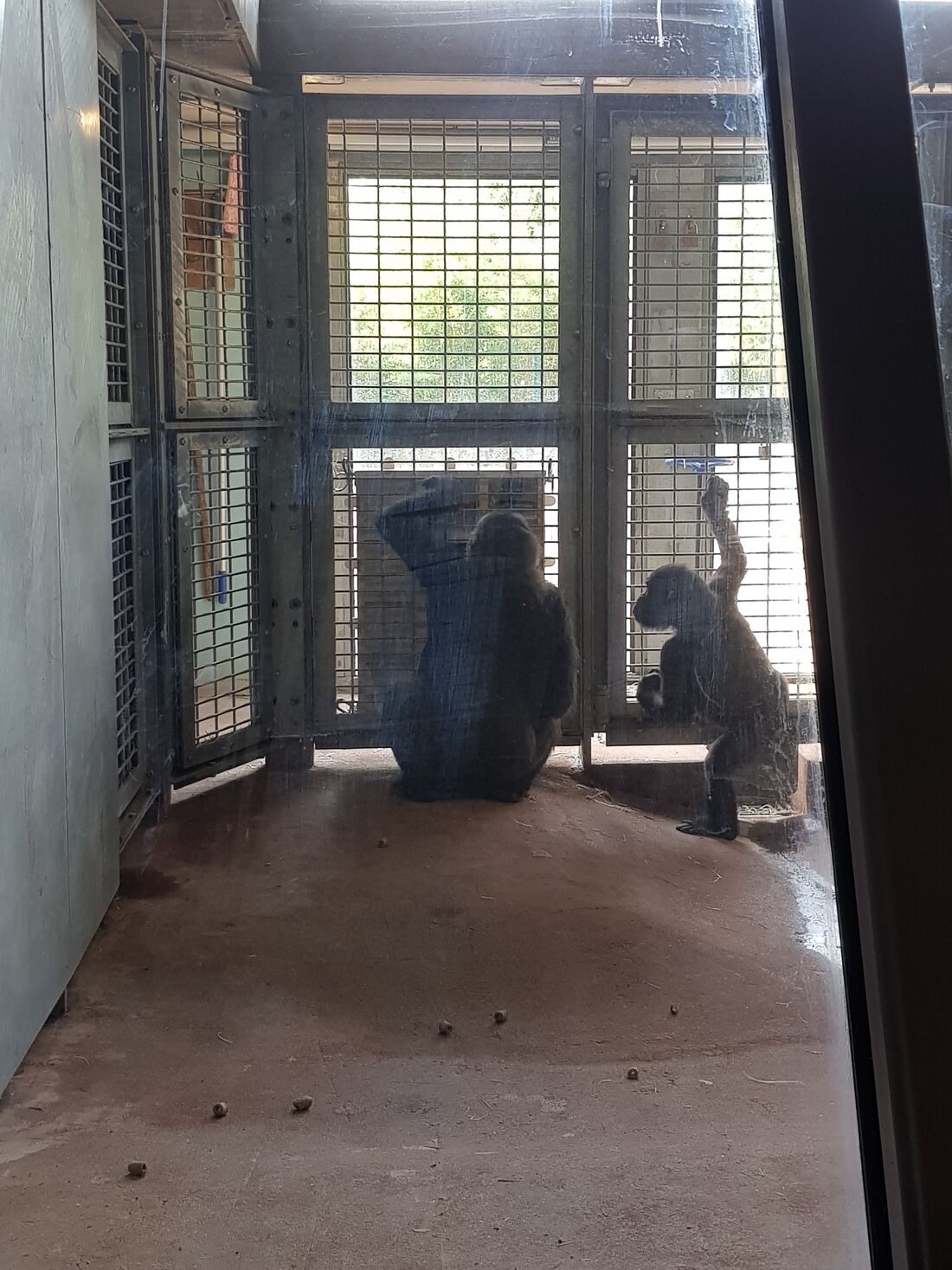
Once the prototype was fully assembled, it was time to see how it fared in the real world. We installed the system in a previously underutilised corner of the gorilla enclosure — an intentional move to activate new spatial behaviour and draw attention to a less explored area. Each modular unit was baited with small rewards such as peanuts and hazelnuts to spark curiosity. To understand how the gorillas responded, we used a multi-method evaluation strategy:
- Observational data. I worked with the team to collect behavioural observations, combining video analysis with in-situ note-taking, focusing on problem-solving strategies, time spent per module, and social dynamics during use.
- Device module logging. We tracked how each module was interacted with over time — logging which designs maintained interest, which wore out, and how they were approached by different individuals.
- Zoo staff feedback. I gathered input directly from keepers about ease of setup, time taken to clean and reset modules, and any changes in gorilla routines or social behaviour during deployment.
Across these methods, we tracked three core metrics: engagement (how many minutes the gorillas spent actively interacting), cognitive challenge (whether they attempted tool use or inventive strategies to access rewards), and durability (how well the frame and modules held up under rough treatment).
Findings: curiosity, play, and social learning
As soon as the prototype was introduced, the adult gorillas approached it with confidence — poking, pulling, and exploring each module with evident interest. Their curiosity translated into active problem-solving, with several individuals returning multiple times during a single session — far more sustained engagement than typically seen with standard feeders. Meanwhile, the younger gorillas stood back and observed, watching the older individuals navigate the puzzles before attempting them themselves. This mirrored behaviour suggested social learning was at play — an encouraging sign that the enrichment might foster group-based cognitive engagement, not just individual curiosity.
We also saw how dominance affected play. More assertive gorillas, especially those higher in the troop hierarchy, were quick to claim the more accessible modules, limiting early access for others. But once those individuals lost interest, lower-ranking gorillas stepped in, and we observed moments of shared play — especially between mother-infant pairs and small subgroups. This validated our strategy of offering multiple modules simultaneously, creating natural opportunities for equitable access and reducing conflict over resources.
"Cheating" gorillas
Some of the most striking moments came when gorillas devised inventive shortcuts to reach the rewards — clever problem-solving captured on film that later became part of our media coverage. (A short "cheating gorillas" clip documented this behaviour, illustrating just how readily the troop rose to a fresh cognitive challenge.)
Durability and zookeeper impressions
Structurally, the puzzle system held up well under pressure. The plywood and acrylic mainframe withstood considerable force — being pushed, rocked, and tugged repeatedly. A few weaker joints needed reinforcement and some smaller components required more secure anchoring to prevent wear, but crucially there were no sharp edges or hazardous breakages, and the locked-in components effectively prevented any risk of ingestion.
Zookeepers reported that the system was easy to mount and maintain, fitting smoothly into their daily routines. They particularly valued the modular design, which let them swap puzzle elements quickly to keep things fresh without demanding extra staff time, and cleaning was efficient thanks to the accessible layout and non-porous surfaces. Perhaps most promising was the response to sensor integration: though still early-stage, passive tracking was met with enthusiasm, with staff keen to use the data to understand individual engagement patterns and identify preferences — ultimately supporting more tailored enrichment strategies.
6 · Launch — showcasing the work
Gorilla Game Lab culminated in a launch event at Bristol Zoo, bringing together collaborators, stakeholders, and the public to celebrate the project's achievements. The event featured a keynote in which I guided the audience through the problem space, the design vision, and the implementation process, emphasising the significant findings and the role of interdisciplinary collaboration between the University of Bristol, Bristol Zoo, and international partners. A lively panel discussion followed, featuring BBC TV's Professor Ben Garrod, designer Tom Metcalfe, Bristol Zoo keepers, and University of Bristol academics, who shared perspectives on the challenges, creativity, and potential for innovation in animal enrichment design.
The launch period saw widespread media attention. I conducted TV interviews for Reuters and a radio interview for Talk Radio, while Fay Clark later represented the project with a talk for New Scientist. The work was picked up internationally, including by the New York Post, the Times of India, and NBC. On the academic stage, I presented the written publications at the International Animal-Computer Interaction Conference in Atlanta, Georgia, where the work earned Presentation of the Year — recognition that underscored the project's influence and paved the way for further collaboration with Aalto University and Korkeasaari Zoo in Helsinki on future animal-computer interaction initiatives.
Gorilla Game Lab V2 — adding computer vision
A second phase extended the system with a computer vision component, realised by Dr Tilo Burghardt and Otto Brookes, experts in computer vision at the University of Bristol. The system used facial recognition tailored to the unique facial features of western lowland gorillas, employing machine-learning algorithms to accurately identify individual gorillas within the enclosure.
- Individual identification. Distinguishing between gorillas allowed personalised data collection on interaction patterns.
- Automated monitoring. Continuous observation of the enrichment device captured the frequency and duration of use by each gorilla.
- Data integration. Visual data merged seamlessly with sensor inputs from the device, providing a comprehensive overview of engagement metrics.
High-resolution cameras were installed near the enrichment device to capture facial images during interactions, and a dataset of labelled gorilla faces was compiled to train the model across varied lighting and angles. We evaluated the system by comparing its performance to traditional human observation, assessing accuracy, time efficiency, and resource allocation. The result was enhanced data accuracy with reduced human error, greater resource efficiency that freed staff for other critical tasks, and richer behavioural insights into individual preferences and social dynamics — representing a significant step towards automating animal behaviour monitoring, with clear potential to extend to other behaviours and species.
Reflections
Leading Gorilla Game Lab taught me how much rigour an animal-centred design process demands — designing for users who cannot tell you what they want forces you to observe more carefully, lean harder on domain experts, and let behaviour, rather than assumption, drive every decision. Bringing together animal welfare science, creative technology, and learning psychology, and coordinating across the university, the zoo, and international partners, also sharpened my skills as a project lead, stakeholder manager, and communicator across both academic and public audiences.
Above all, the project showed that welfare-led technology in captive animal environments is both possible and valuable — but only when the technology serves the animal and fits the human routines around it. A modular, durable, data-driven system can keep remarkable creatures mentally stimulated while respecting their agency and the realities of zoo life, and that holistic balance, more than any single clever feature, is what made the work resonate.
Selected publications
Brookes, O., Gray, S., Bennett, P., Burgess, K.V., Clark, F.E., Roberts, E. & Burghardt, T. (2022). Evaluating cognitive enrichment for zoo-housed gorillas using facial recognition. Frontiers in Veterinary Science, 9, 886720.
Clark, F.E., Gray, S.I., Bennett, P., Mason, L.J. & Burgess, K.V. (2019). High-tech and tactile: cognitive enrichment for zoo-housed gorillas. Frontiers in Psychology, 10, 1574.
Gray, S., Clark, F., Burgess, K., Metcalfe, T., Kadijevic, A., Cater, K. & Bennett, P. (2018). Gorilla Game Lab: exploring modularity, tangibility and playful engagement in cognitive enrichment design. ACI 2018 — Presentation of the Year.
Keep exploring
More case studies
SpaceVision
A participatory, child-centred redesign of a game for diagnosing children's eye disease.
View case study →
Critter Jam
A location-aware mobile exergame to promote children's physical activity.
View case study →
VR100
Using design fiction and immersive theatre to explore the ethics of VR.
View case study →